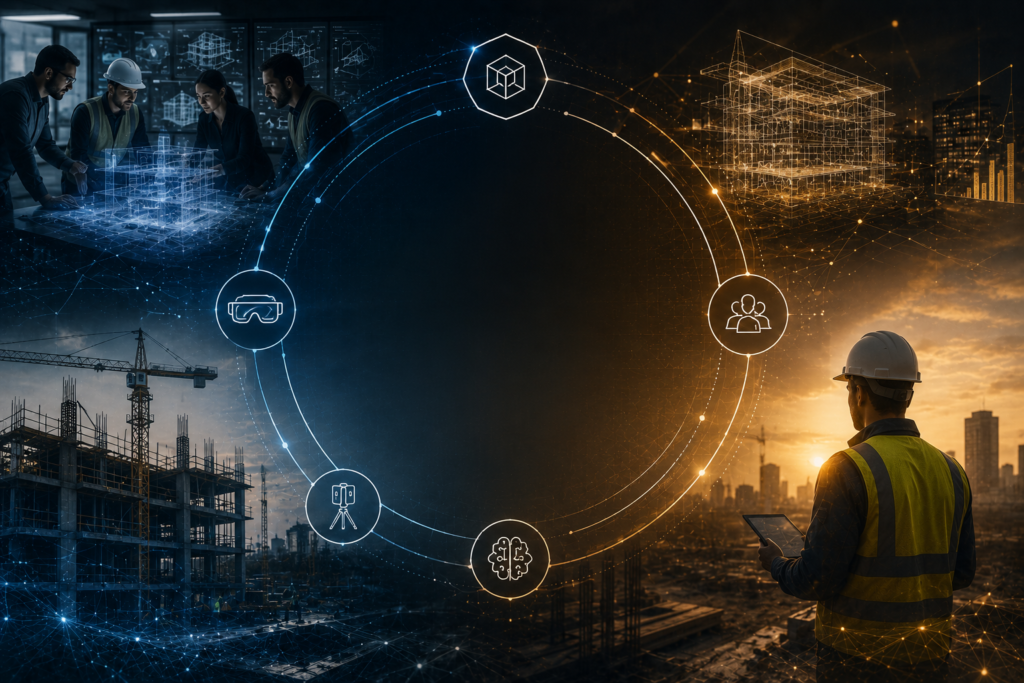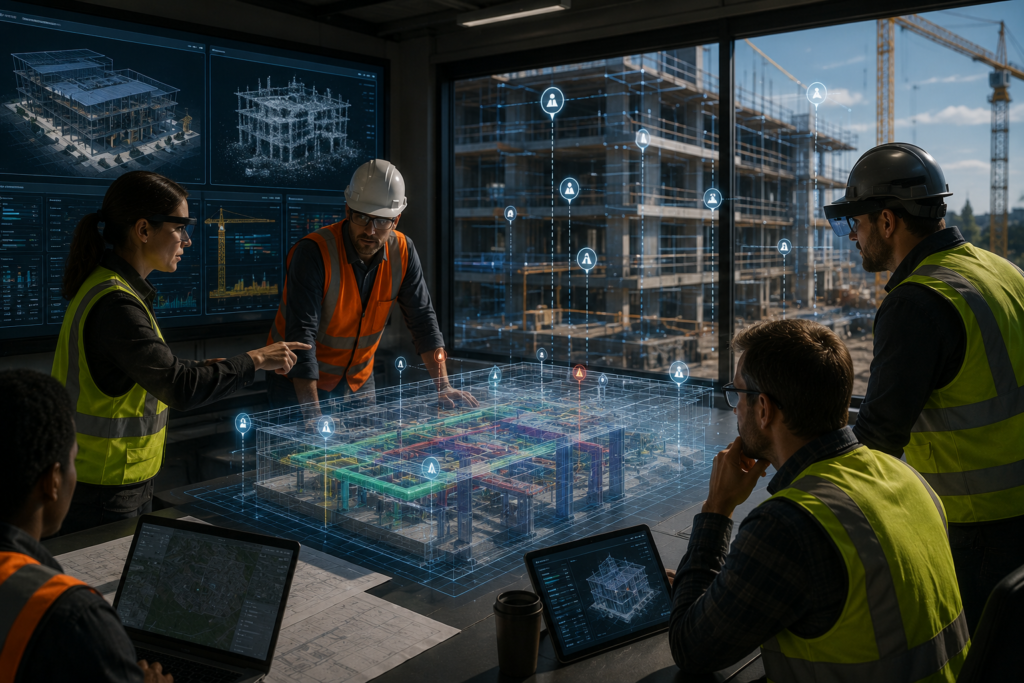
Construction teams now have access to powerful AR, VR, Digital Twins, Reality Capture, BIM, mobile capture, and immersive visualization tools. The question is no longer only whether these technologies work. The harder question is whether organizations can integrate them into everyday workflows. That distinction matters.
For years, much of the construction technology conversation focused on proving that immersive tools were technically possible. Could teams walk through a model in VR? Could AR overlay project information in the field? Could reality capture document jobsite conditions? Could digital twins represent complex buildings, infrastructure, and assets?
Today, the answer is increasingly yes. The next challenge is adoption. How do teams make these tools useful in the daily rhythm of design coordination, preconstruction, site planning, safety training, installation, inspection, operations, and handover?
Autodesk’s Digital Builder episode on extended reality in construction highlights this shift. The discussion features Gary Cowan, Head of Digital Construction at Kane Group, and focuses on how AR and VR are being used for design reviews, coordination, training, installation planning, and model-to-field feedback loops.
The key lesson is clear:
 The future of construction won’t be transformed by technology alone. It will be transformed by how effectively people use it.
Extended Reality is moving beyond pilot projects into practical construction workflows.
This is an important shift because construction has no shortage of digital tools. Teams already work with drawings, models, schedules, RFIs, submittals, field reports, BIM coordination platforms, document management systems, mobile apps, laser scans, and project dashboards.
The issue is not simply whether more information exists. The issue is whether the right information reaches the right people at the right moment, in the right context. That is where Spatial Computing becomes valuable.
XR can help construction teams move from abstract project information to embodied understanding. Instead of only reviewing a dense model on a flat screen, teams can step into the environment, understand scale, identify conflicts, discuss design intent, and experience a project before it is built.
Autodesk’s article describes how Kane Group uses XR across design reviews, collaboration, project delivery, training, visualization, and installation planning. It also emphasizes one of the most important adoption realities: XR adoption depends on workflows, data quality, and collaboration, not just the technology. (Autodesk)
That is the real story. The most valuable construction XR use cases are not isolated demonstrations. They are workflow improvements. They include:
 Design reviews before construction Immersive safety and workforce training On-site visualization of project data Installation planning Model-to-field feedback loops Better coordination between design, BIM, and operations teams Early detection of constructability issues
This enables:
 Better communication Faster decision-making Reduced project risk Stronger team alignment Earlier issue detection More confident field execution
For construction, the greatest value comes when immersive technology fits naturally into existing workflows.
XR succeeds when it supports how teams already need to make decisions.
Construction generates enormous amounts of project data. Models. Drawings. Schedules. Specifications. Laser scans. Photos. RFIs. Submittals. Field reports. Issue logs. Safety documentation. Asset data. Handover information.
But accessing that information in the field remains a major challenge. A jobsite is not a desk.
Field teams are mobile. Conditions change constantly. Work is physical, spatial, and time-sensitive. Decisions often happen around real objects, incomplete installations, temporary conditions, and coordination challenges that are difficult to fully understand from a screen.
Spatial Computing can help connect digital project information directly to the physical environment. That matters because construction work is inherently spatial. Clearances, tolerances, sequencing, access zones, equipment placement, MEP routing, safety constraints, prefabrication, logistics, and installation planning all depend on understanding space. A 2D drawing may communicate intent. A BIM model may organize information. A coordination platform may track issues. A reality capture dataset may document conditions.
But Spatial Computing can help teams experience those relationships in context. This enables: Better project coordination More informed field decisions Stronger collaboration across disciplines Earlier identification of spatial conflicts Improved training before site exposure Better alignment between design intent and field reality
Autodesk’s Digital Builder article highlights this exact gap between design intent and field reality. It notes that small details not captured early enough can become major site issues, and that immersive design reviews can help teams think through more scenarios before construction begins. (Autodesk)
That is where enterprise Spatial Computing becomes meaningful. Not as a novelty. As a decision-support layer.
Information becomes more valuable when it is experienced in context.
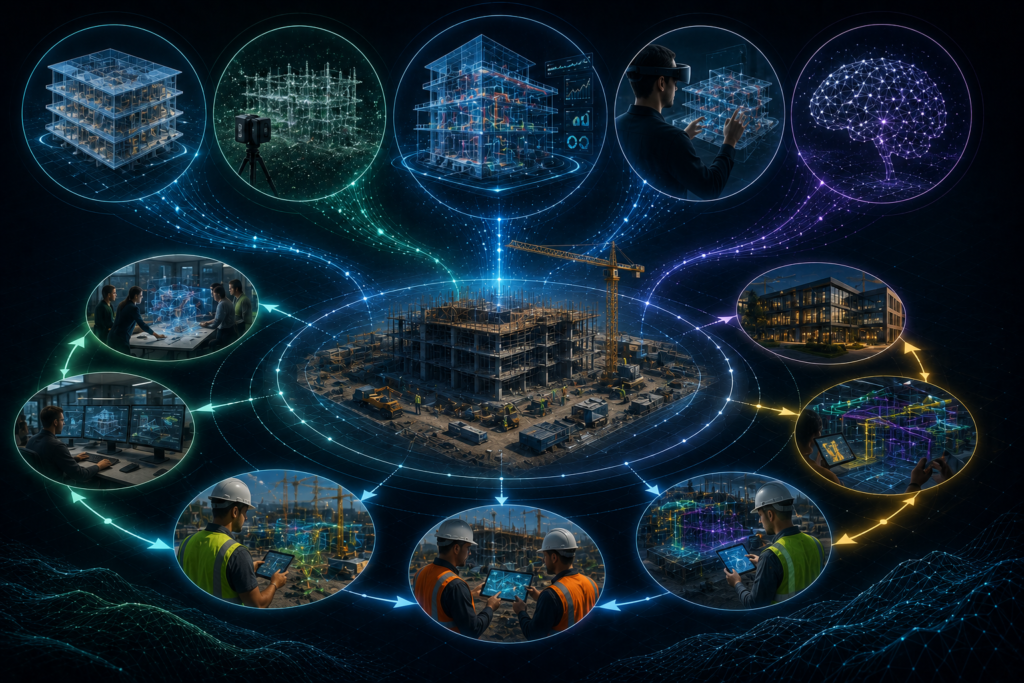
We are seeing several enterprise technologies rapidly converge: Spatial Computing Artificial Intelligence Digital Twins Reality Capture BIM GIS Virtual Positioning Systems Construction management platforms
Together, they are reshaping how projects are planned, built, and maintained. This convergence matters because construction is one of the most spatially complex industries in the world.
Every project is a physical prototype. Every jobsite is dynamic. Every discipline depends on spatial coordination. Every delay can become expensive. Every misunderstanding can create risk.
For years, the industry has digitized pieces of the construction process. Drawings became digital. Models became collaborative. Documents moved to cloud platforms. Reality capture improved documentation. Digital twins extended information into operations.
Spatial Computing may be the next layer. It brings digital project information into the physical and immersive context where people can understand it more naturally. AI will likely accelerate this shift. The Autodesk article closes with a forward-looking discussion of AI and XR, including the idea that construction professionals may increasingly interact with AI assistants inside immersive environments. (Autodesk)
That future is important. Imagine a construction professional standing inside an immersive model or on an active jobsite and asking: What coordination issues are open in this area? Does this installation match the latest model? What changed since the last scan? What safety risks should I review before work begins? Which trade is responsible for this issue? What does the schedule say about this zone? Show me the design intent for this room.
That is where Spatial Computing, AI, Digital Twins, and Reality Capture begin to work together. Construction is becoming one of the world’s largest real-world applications of Spatial Computing.
The opportunity is not just immersive visualization. It is spatial decision-making.
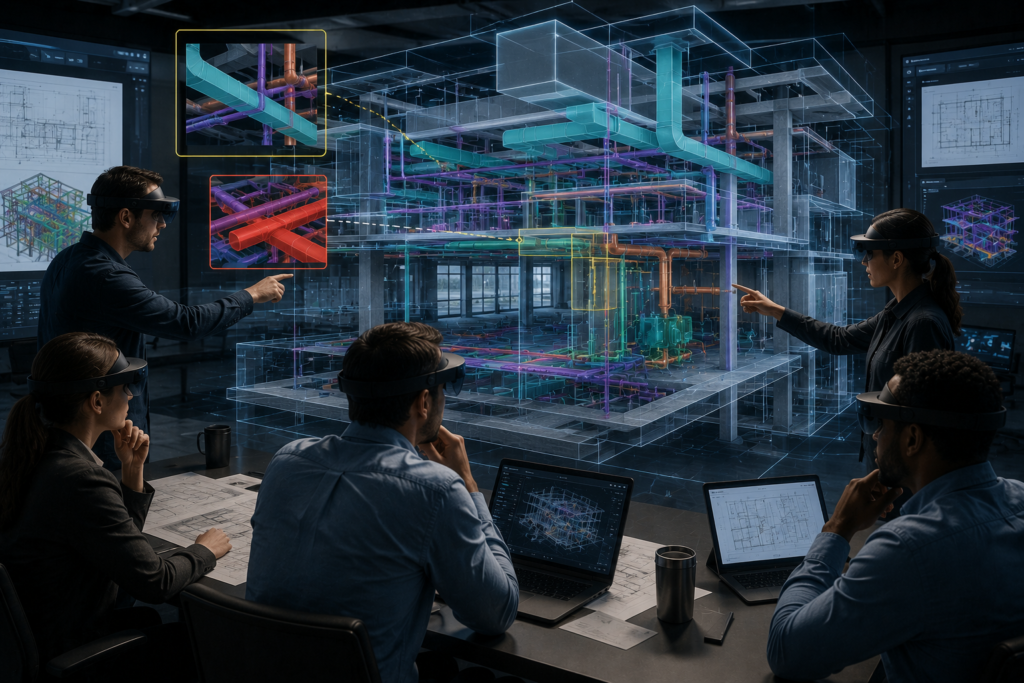
Design reviews are one of the most mature use cases for VR in construction. When teams step into a model, they can understand scale, clearance, access, and design intent more clearly than they often can on a 2D screen.
This is especially valuable for dense or complex systems. Autodesk’s article describes a Kane Group hotel project involving roughly 11 kilometers of pipework and prefabrication, where the model was so dense that a standard screen review was not enough. (Autodesk)
Immersive design reviews can help teams: Identify spatial conflicts earlier Improve stakeholder understanding Reduce coordination delays Validate access and maintenance space Review design options more clearly
XR can help workers become familiar with project environments before entering the jobsite. This matters for safety, productivity, and confidence. Training in an immersive environment can help teams understand hazards, sequences, equipment, site logistics, and installation steps before work begins.
Potential training uses include: Safety onboarding Equipment familiarization Installation sequencing Emergency procedures Site-specific orientation Workforce upskilling
Digital twins become more useful when teams can experience them spatially. Instead of treating the digital twin as a dashboard or model viewer, Spatial Computing can turn it into an interactive operational environment.
This can support: Asset visualization Facility operations Maintenance planning Inspection workflows Lifecycle handover Owner engagement
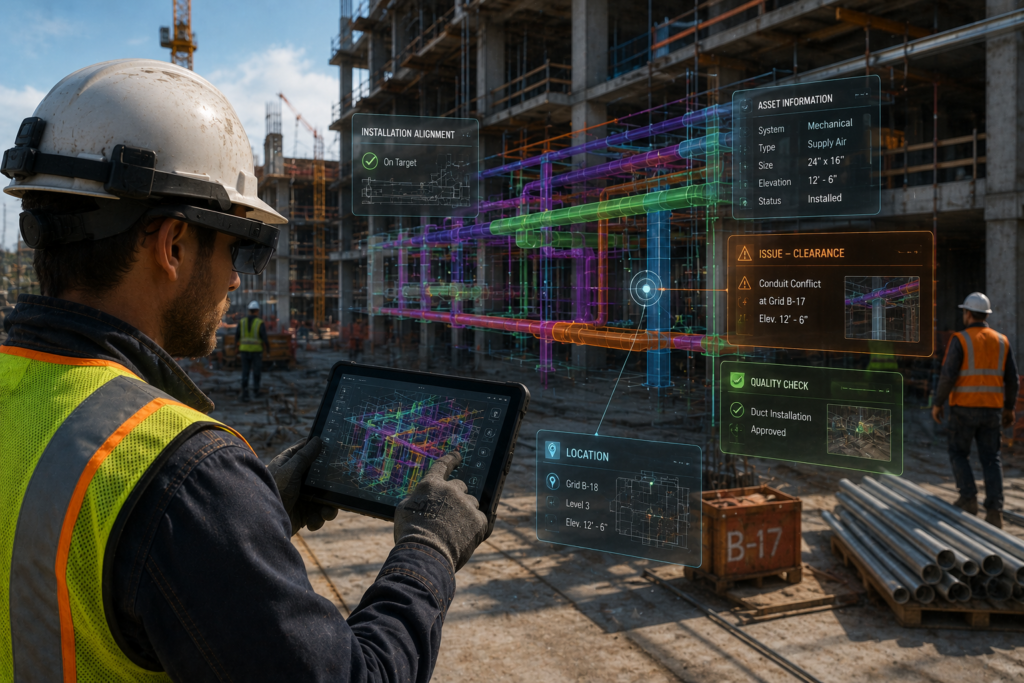
Field operations may become one of the largest opportunities for Spatial Computing in construction. AR and mobile spatial tools can help bring project data into the jobsite, but only if the data is accurate, aligned, and workflow-ready.
Potential field uses include: Issue tracking Model comparison Progress documentation Installation guidance As-built verification Reality capture review Punch list support
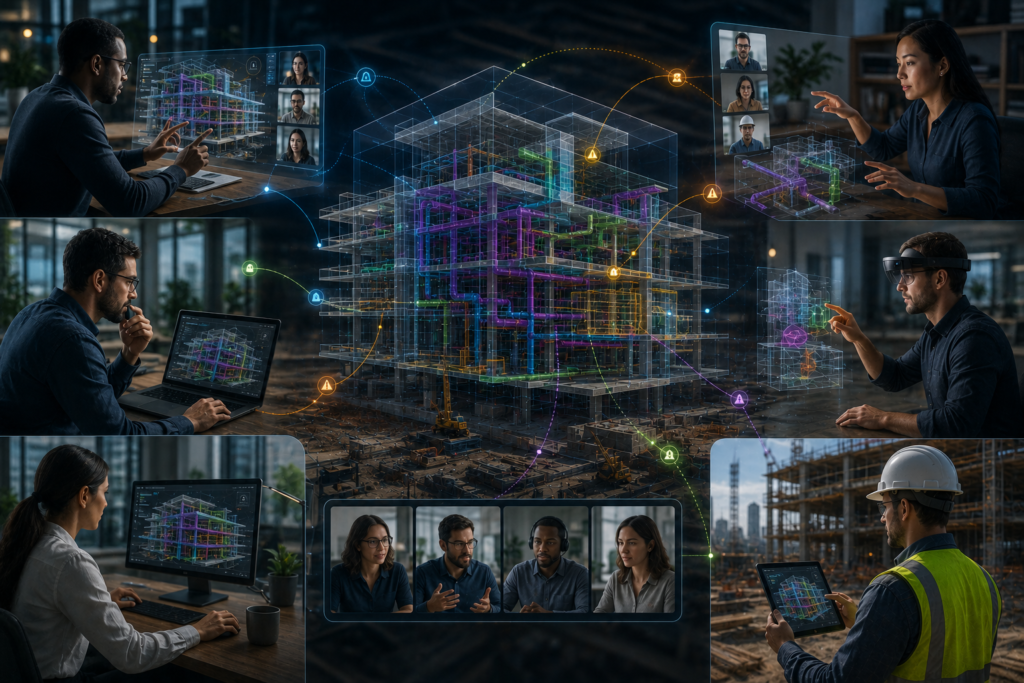
Successful Spatial Computing initiatives do not begin with the headset. They begin with a clearly defined business problem. That is one of the biggest lessons construction firms need to internalize.
If the goal is simply “use VR” or “try AR,” adoption will likely stall. The technology may impress people during a demo, but it will struggle to become part of daily work.
But if the goal is: Reduce coordination issues Improve safety training Help field teams understand complex installations Catch design problems earlier Connect digital twins to operations Improve stakeholder decision-making
Then Spatial Computing has a clear role. That role must be tied to process. Who prepares the model? What level of detail is needed? Who reviews the experience? How are issues captured? Where does feedback go? How does it connect to existing project systems? How does the field team access it? How is success measured?
This is where many XR initiatives succeed or fail. Enterprise XR succeeds when it becomes part of the workflow rather than a separate experience. The headset is not the strategy. The workflow is the strategy.
The future of construction won’t be defined by who adopts Spatial Computing first. It will be defined by who integrates it best.
Spatial Computing in construction is moving from technology exploration to workflow integration.
The most successful firms will not be the ones that simply buy headsets. They will be the ones that connect AR, VR, Digital Twins, Reality Capture, BIM, AI, and field operations into practical decision-making workflows.
That is where immersive technology becomes business value.
Over the next 2–5 years, construction Spatial Computing will likely become more practical, connected, and workflow-driven.
Several shifts will accelerate adoption.
First, headsets and mobile AR tools will become easier to deploy. Standalone devices, improved passthrough, better tracking, and lighter form factors will reduce friction.
Second, digital twins and reality capture will become more connected to project delivery. More teams will expect scans, models, and field data to feed into living project systems.
Third, AI will become part of immersive workflows. Construction professionals may increasingly use AI assistants to query models, summarize issues, compare scans, explain sequences, and surface relevant information inside spatial environments.
Fourth, Spatial Computing will become more role-specific. Designers, owners, field crews, safety teams, facilities teams, and project managers do not all need the same experience. The highest-value tools will support specific decisions for specific users.
Fifth, integration with existing platforms will matter more than standalone demos. XR will need to connect with BIM, document control, scheduling, issue tracking, asset management, and field collaboration systems.
That is when the industry will move from immersive pilots to operational adoption.
The future of construction will not be transformed by technology alone. It will be transformed by how effectively people use it.