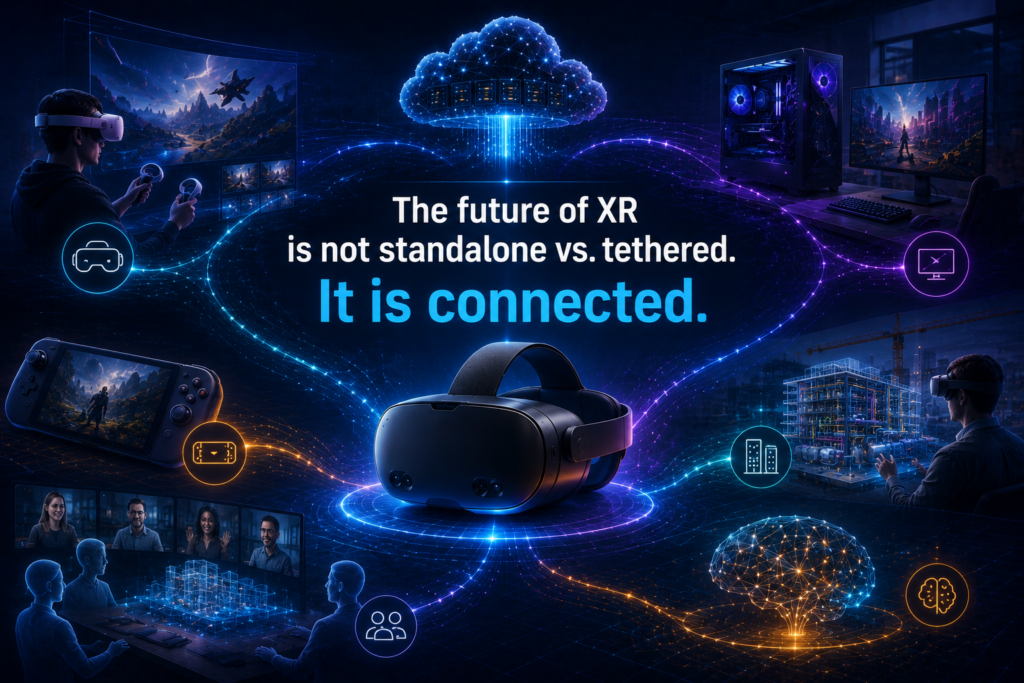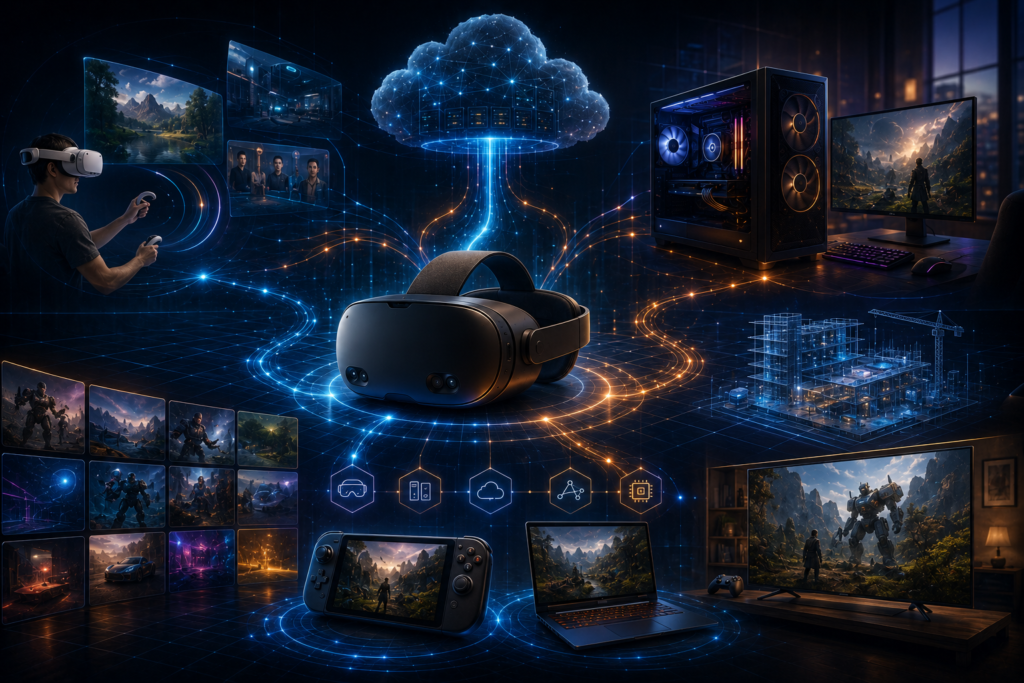
Valve’s Steam Frame is not just another VR headset announcement. It points toward a larger question the XR industry has been wrestling with for years:
Should immersive devices prioritize standalone convenience, or should they preserve the performance of high-end PC VR?
For much of the modern VR market, those two directions have felt separate. Standalone headsets made VR easier to use.
PC VR delivered higher performance and deeper immersion. But users have often been forced to choose between convenience and power.
Steam Frame points toward a more flexible future: XR devices that can operate across multiple compute modes, connect to larger ecosystems, and adapt based on the experience. That matters because the future of XR may be defined less by individual devices and more by how intelligently those devices connect to software, compute, content, cloud services, and user workflows.
 The future of XR may be defined less by devices and more by how they connect to larger ecosystems.
Valve has officially introduced Steam Frame as a streaming-first wireless VR headset designed around the Steam ecosystem. The most important idea is not simply that Valve has another headset. It is that Steam Frame appears designed around flexibility.
According to Valve’s Steam Frame page, the headset is positioned as a wireless VR headset and controller system that can handle the user’s Steam library. Reporting from PC Gamer describes Steam Frame as a standalone VR headset that does not require a PC, base stations, or cables, while also emphasizing that Valve sees it as a “streaming first” device for wireless PC VR through a dedicated 6 GHz adapter.
That combination is important. Steam Frame is not just trying to be a standalone headset. It is not just trying to be a traditional PC VR headset. It is attempting to connect both modes through the Steam ecosystem.
The reported technical direction includes:
 Standalone VR functionality Wireless PC VR streaming SteamOS integration Arm-based processing Compatibility work through Proton and FEX A dedicated wireless adapter for PC streaming Inside-out tracking instead of external base stations Access to both VR and non-VR Steam content
This matters because Valve’s biggest asset has never been hardware alone.
Valve has Steam. Valve has SteamOS. Valve has SteamVR. Valve has Steam Deck momentum. Valve has Proton. Valve has a massive PC gaming library. Valve has a developer and enthusiast ecosystem.
Steam Frame is interesting because it could bring those pieces together into a more unified immersive computing stack. Instead of asking users to choose between standalone mobility and PC-powered performance, hybrid XR platforms could allow users to move between modes:
 Portable when mobility matters Powerful when performance matters Connected when ecosystem continuity matters
Hybrid computing could become the new standard for XR.
Spatial Computing is not only about displays, sensors, or headsets. It is about creating computing experiences that understand space, respond to context, and connect digital content to the physical world. To make that work at scale, devices need more than good hardware. They need flexible compute models.
That is where hybrid XR becomes important. Today, the XR market balances two major approaches: Standalone convenience
 High-end PC immersion
Standalone headsets are easier to use. They reduce setup friction, remove cables, and make immersive experiences more accessible. This is one reason standalone devices helped expand the consumer VR market. But standalone devices are limited by mobile processors, battery constraints, thermal budgets, and onboard storage.
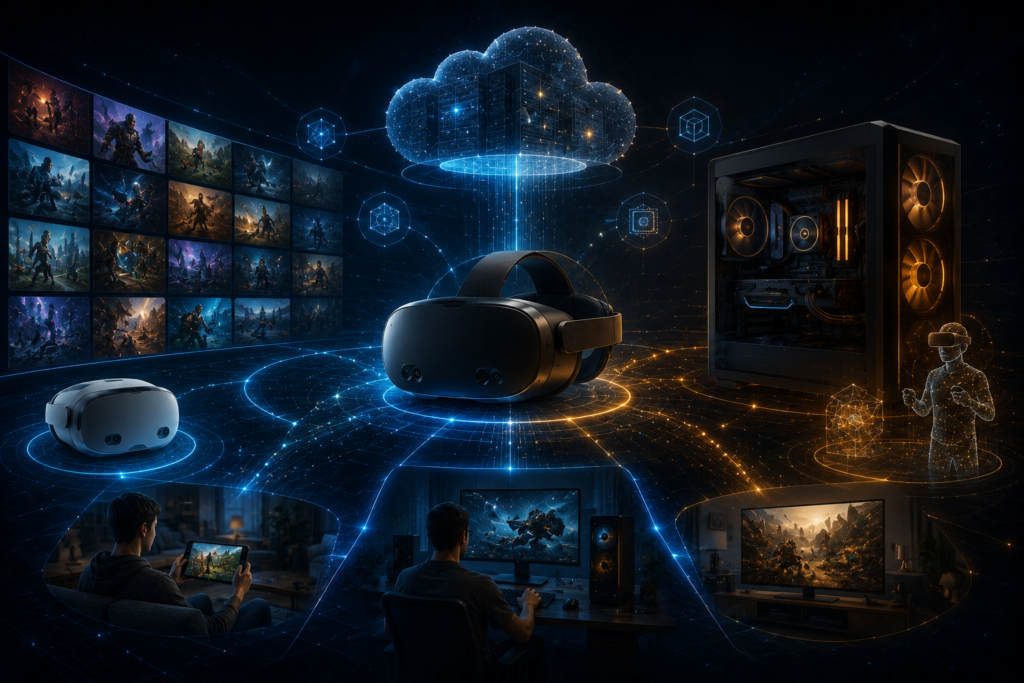
PC VR delivers more graphical power, larger simulation capacity, richer environments, and higher-fidelity rendering, but it traditionally requires more setup, more hardware, more space, and more friction. Hybrid XR attempts to combine both. A headset can run lightweight experiences locally, stream demanding experiences from a PC, and potentially connect to cloud or edge compute for other workloads. That creates a more elastic model for Spatial Computing.
Instead of one device doing everything the same way all the time, the system can adapt:
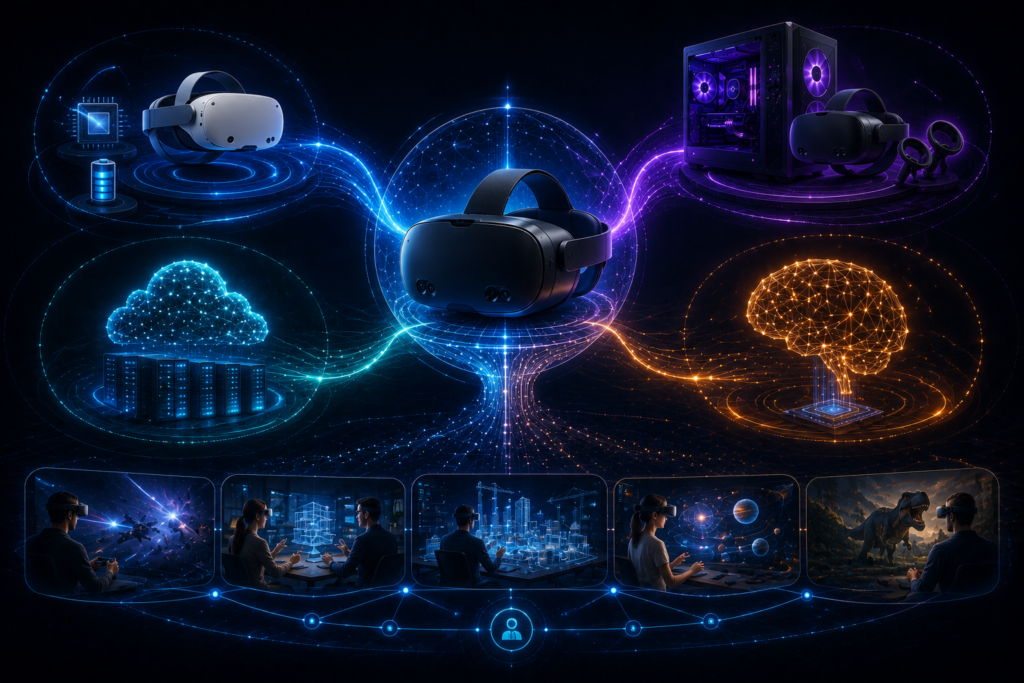
Local compute for mobility PC compute for high-end immersion Cloud compute for scalable rendering or AI services Edge compute for enterprise or location-based workflows Ecosystem sync for continuity across devices
This matters because the future of Spatial Computing will likely include many different experience types.
Some will be lightweight and ambient. Some will be high-performance and immersive. Some will be collaborative. Some will be streamed. Some will run locally. Some will connect to enterprise platforms.
Users should not have to choose between power and convenience every time they enter XR.
Users should not have to choose between power and convenience.
Steam Frame fits into a much larger pattern across the future of computing.
We are seeing convergence between:
PC gaming ecosystems Cloud streaming XR hardware
 AI-driven optimization
 Game libraries
 Mobile-style convenience
 Cross-device platforms
 Connected services
The old model of computing was device-centric. A console was a console. A PC was a PC. A headset was a headset. A handheld was a handheld.
But the future is becoming more ecosystem-centric.
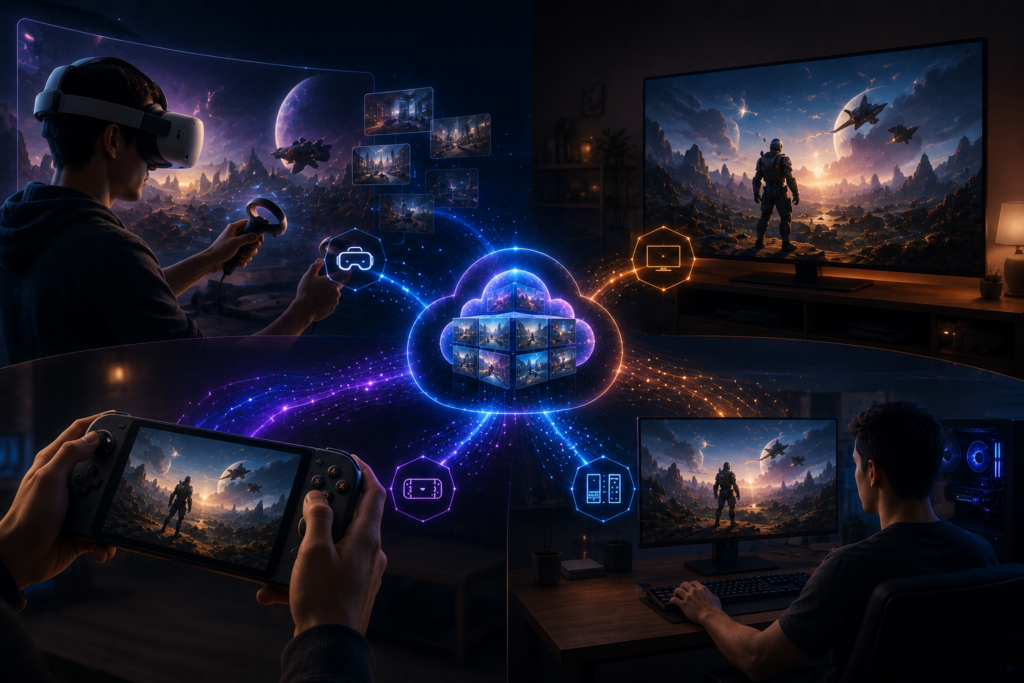
A user may start a game on a handheld, continue it on a PC, stream it to a headset, share it through a social layer, and interact with AI-powered tools along the way. Valve has already been moving in this direction with Steam Deck, SteamOS, Proton, and the broader idea of making PC gaming more portable and flexible. Steam Frame appears to extend that same thinking into XR.
This is why the device is strategically interesting.
It is not just about whether Steam Frame has the best display, the lightest form factor, or the most powerful chip. The bigger question is whether Valve can make XR feel like a natural extension of the Steam ecosystem. If the answer is yes, Steam Frame could help shift the industry conversation from isolated headset categories to connected immersive ecosystems.
That points toward:
Elastic compute for XR Device interoperability More scalable immersive experiences Cross-device libraries Persistent user identity and content ownership Lower friction between flat games and immersive games A more open alternative to closed XR platforms
This is the bigger pattern: The future of XR may not be defined by whether a headset is standalone, tethered, or streamed. It may be defined by how intelligently the ecosystem combines those modes.
The future of XR may be defined by connected ecosystems rather than individual devices.
Gaming is the obvious starting point. A hybrid XR platform could allow users to stream high-end PC VR titles, run lighter experiences locally, and access traditional flat games in immersive viewing environments. This could make XR more approachable because users are not limited only to native VR content. Their existing game library becomes part of the value proposition.
Potential benefits include:
Lower friction for PC VR users More flexible play modes Larger content libraries Better continuity across devices Easier access to both immersive and non-immersive games
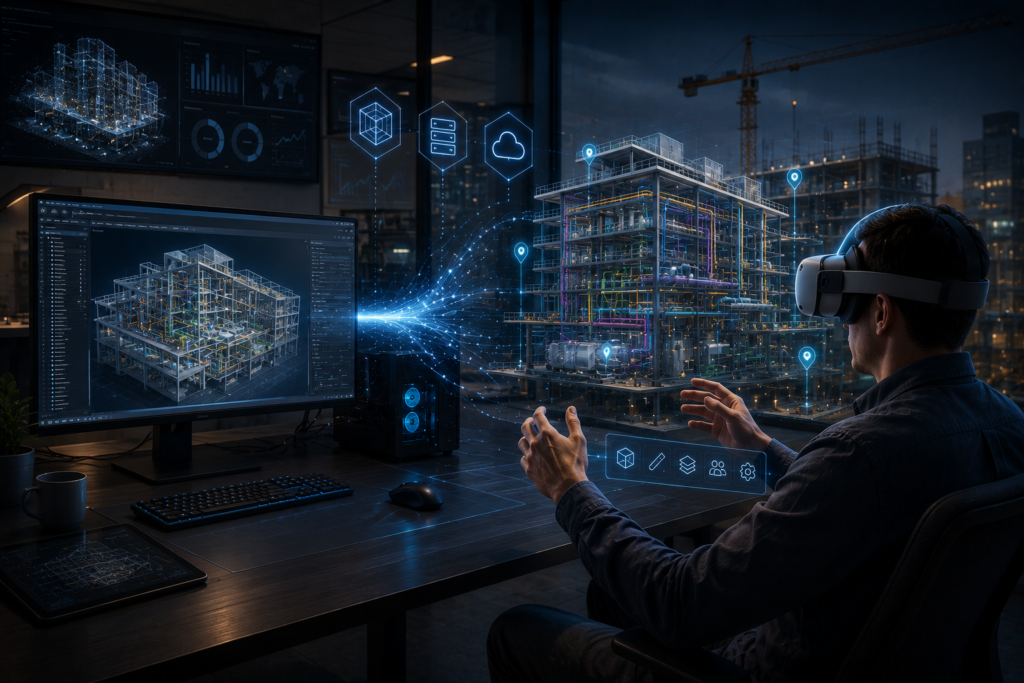
For AECO, hybrid XR could be extremely valuable. A headset could run lightweight site review tools locally, but stream high-fidelity digital twins or large BIM/GIS environments from a workstation when needed. That matters because enterprise spatial datasets can be heavy. Large models, reality capture datasets, GIS layers, simulation environments, and digital twins often exceed what mobile hardware can comfortably process on-device.
Hybrid XR could support:
Local field review PC-powered model visualization Cloud-streamed digital twins Collaborative design reviews High-fidelity simulations Remote expert walkthroughs
Schools, universities, and training centers could use hybrid XR to make immersive learning more flexible. Basic modules could run standalone. Advanced simulations could stream from a lab PC or cloud environment.
Cloud XR and Enterprise Platforms
In the long term, hybrid XR may blend local, PC, cloud, and edge compute into one experience layer. For enterprise, this matters because the right compute model may depend on security, latency, bandwidth, cost, and workflow requirements.
A connected XR ecosystem could dynamically choose the right compute path for the task. That is where hybrid XR becomes more than a gaming feature. It becomes a computing architecture.
I think this hybrid direction makes a lot of sense. The future of XR likely will not be one device type dominating everything.
Instead, we will see a connected mix of:
Standalone workflows PC-enhanced immersion Cloud-powered experiences Edge-enabled enterprise applications Smart glasses for ambient computing Headsets for deeper spatial workflows
That is why Steam Frame is interesting.
Valve’s biggest strength has never been just the headset. It is the ecosystem. The Steam ecosystem already gives Valve a foundation most XR hardware companies do not have: a massive library, a user base, developer relationships, operating system strategy, and a culture of experimentation around PC gaming.
The real question is whether Valve can make XR feel like a natural extension of Steam rather than a separate category. That is the strategic opportunity. The XR industry has spent years arguing over standalone versus tethered, mobile versus PC, open versus closed, gaming versus productivity, and consumer versus enterprise.
But the more interesting future may be adaptive. The device runs locally when that is enough.
It streams when more power is needed. It connects to cloud services when scale matters. It integrates with AI when optimization or context is needed. It moves across devices when continuity matters.
That is the direction Spatial Computing should move. Not one device trying to do everything alone. A connected ecosystem where each compute layer contributes what it does best.
The companies that succeed in XR may not be the ones that build the best headset. They may be the ones that connect the most experiences.
Over the next 2–5 years, hybrid XR will likely become more important. Several trends are pushing the market in that direction.
First, immersive content is becoming more demanding. Higher-resolution displays, richer environments, advanced physics, multiplayer collaboration, realistic avatars, AI-driven agents, and digital twin datasets all require more compute.
Second, users expect convenience. The market has shown that setup friction matters. Cables, base stations, complex configuration, and dedicated rooms limit adoption for many users.
Third, cloud and edge infrastructure are improving. Not every use case will work well through cloud streaming, especially when latency is critical, but cloud and edge compute will become increasingly important for certain enterprise, training, and collaboration scenarios.
Fourth, AI optimization will become more relevant. Foveated rendering, compression, streaming quality, scene understanding, performance scaling, and interaction prediction could all benefit from AI-driven systems.
Fifth, ecosystems will matter more than isolated hardware. Users will expect their content, identity, preferences, saves, tools, and workflows to move across devices.
For XR, this means the next generation of platforms may not be defined by a single compute model. They may be defined by intelligent orchestration. A headset may choose local compute for simple interactions, PC compute for high-end immersion, cloud compute for scale, and AI services for context.
That is the bigger shift.
The future of XR will not be defined by whether devices are standalone or tethered. It will be defined by how intelligently they work together.