π§ Did you knowβ¦ AWE 2026 may be remembered as the event where AI became the defining story of Spatial Computing? π€π₯½
After attending AWE, one message stood out clearly:
The biggest story was not only the latest headset, glasses, display, or device category.
It was how AI is beginning to make Spatial Computing more intelligent, contextual, and useful.
That shift matters because Spatial Computing has always promised to blend digital content with the physical world. But simply placing content in space is not enough. The next generation of spatial experiences will need to understand the world, reason about context, and respond in ways that are useful to people, teams, and organizations.
That is where AI changes the conversation.
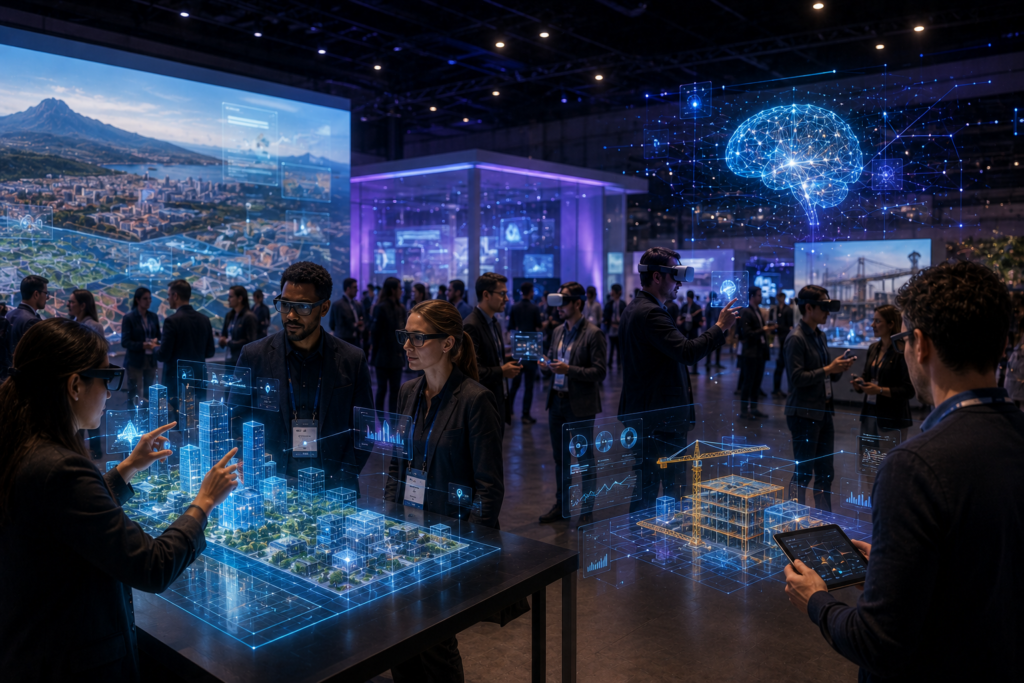
AWE 2026 leaned directly into this shift. The event theme, βI, Spatial: Humans Empowered by Spatial AI,β framed the industry conversation around the intersection of XR, AI, smart glasses, spatial interfaces, and human-centered computing. Forbes contributor Tim Bajarin also described AWE 2026 as a moment where Spatial Computing is moving from experimental novelty toward more practical, AI-driven applications.
π Spatial Computing is no longer just about seeing digital content. It is about understanding the world around us.
π Whatβs Happening?
The Spatial Computing industry is shifting beyond devices toward intelligent, context-aware experiences.
For years, XR conversations were dominated by hardware questions:
πΉ Which headset has the best display?
πΉ Which device has the widest field of view?
πΉ Which controller or input system feels most natural?
πΉ Which platform has the best passthrough?
πΉ Which wearable form factor will consumers accept?
Those questions still matter. Hardware remains important. Comfort, weight, battery life, field of view, display quality, tracking, and price all affect adoption.
But AWE 2026 made something clear:
Hardware alone is no longer the main story.
The industry conversation is now expanding toward intelligence, context, and usefulness. AI is becoming the layer that helps spatial systems interpret what is happening in the world and respond in more meaningful ways.
That includes:
πΉ AI assistants integrated into XR experiences
πΉ Context-aware spatial applications
πΉ Smarter spatial interfaces
πΉ AI-powered content generation
πΉ Scene understanding
πΉ Voice-driven workflows
πΉ Real-time assistance
πΉ Multimodal input across speech, vision, gaze, gestures, and environment data
AI is enabling spatial experiences to become:
β
More natural
β
More contextual
β
More adaptive
β
More useful for enterprise workflows
β
More capable of supporting faster decisions
This is a meaningful shift.
A spatial experience without intelligence can show information.
A spatial experience with AI can help interpret, prioritize, explain, guide, and assist.
That difference is what may define the next phase of the market.
π AI is becoming the intelligence layer connecting digital content to the physical world.
π₯½ Why This Matters for Spatial Computing
Spatial Computing blends digital content with the physical world.
AI adds the ability to understand that world and respond intelligently.
That combination is powerful because the biggest challenge in Spatial Computing is not just rendering digital objects in 3D. It is making spatial experiences relevant to the userβs task, location, environment, intent, and context.
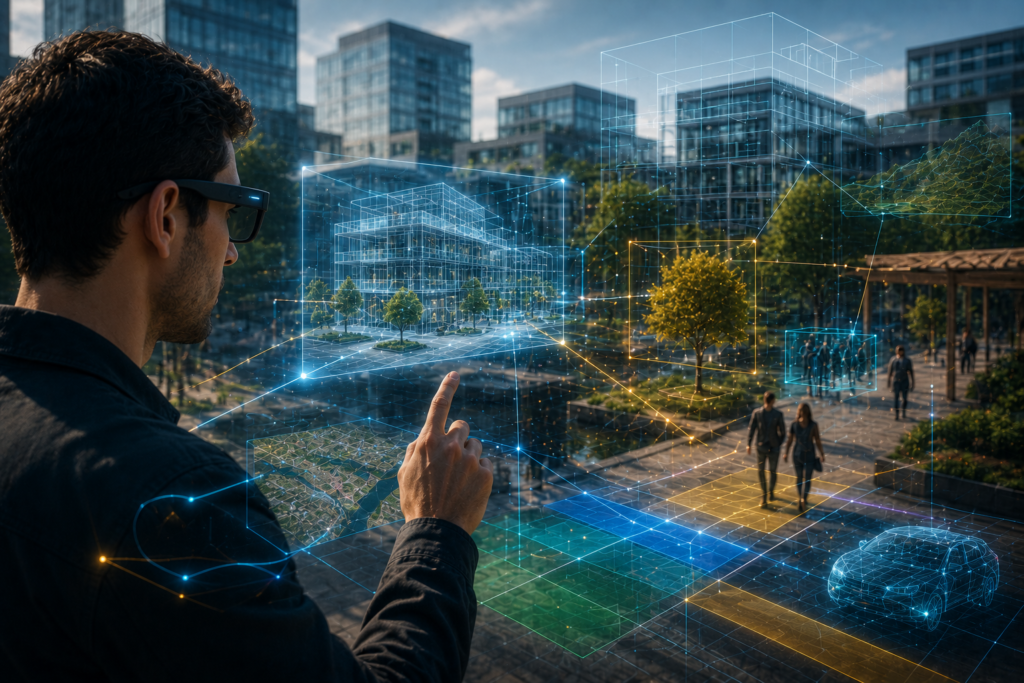
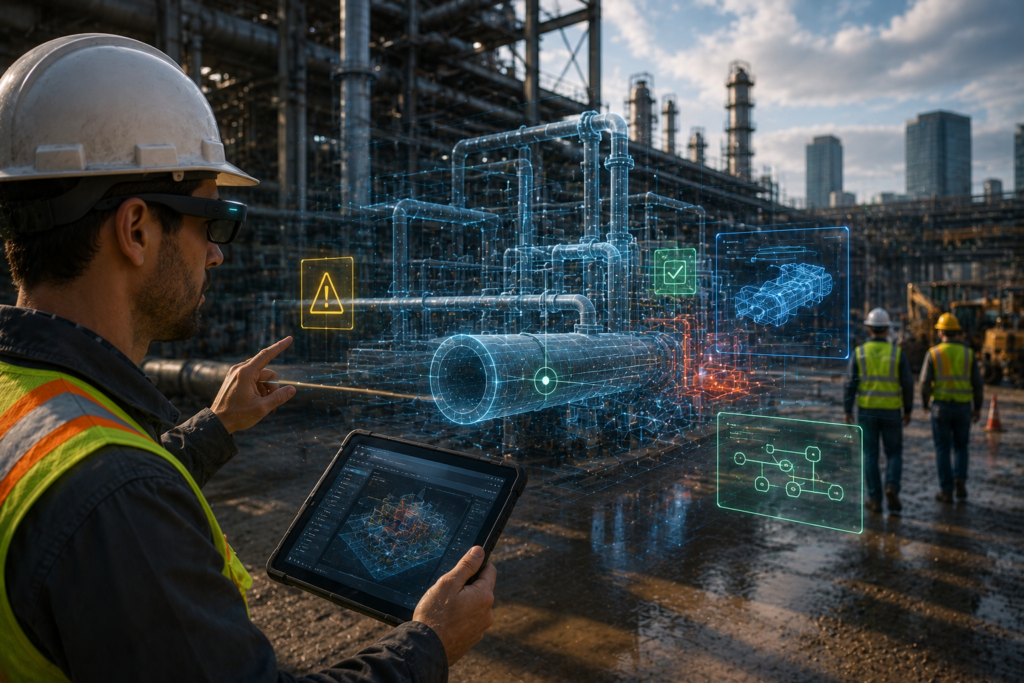
For example, an AR overlay on a construction site is useful only if it aligns with the right asset, reflects current conditions, and supports the task at hand. A digital twin is more valuable when it can explain what is changing, identify anomalies, and guide decisions. A smart glasses assistant becomes more useful when it can understand what the wearer is looking at and provide relevant help without requiring a traditional screen-based workflow.
This is where AI becomes essential.
As Digital Twins, GIS, Reality Capture, and VPS mature, they create a richer spatial data foundation. But spatial data by itself is not enough. Organizations need systems that can interpret that data and help people act on it.
That is where AI can transform spatial information into action.
This enables:
β
Context-aware experiences
β
Intelligent enterprise workflows
β
More useful spatial applications
β
Better decision support
β
More natural human-computer interaction
β
Real-time understanding of places, assets, and tasks
The industry is moving toward a future where Spatial Computing systems do not simply ask, βWhere should this digital object appear?β
They begin asking:
πΉ What is the user trying to do?
πΉ What environment are they in?
πΉ What objects or assets are nearby?
πΉ What information is relevant right now?
πΉ What should the system explain, highlight, warn, summarize, or automate?
That is a fundamentally different computing model.
π Intelligence may become the defining capability of the next generation of spatial experiences.
π The Bigger Pattern
We are watching several major technologies converge at the same time:
πΉ Artificial Intelligence
πΉ Spatial Computing
πΉ Smart Glasses
πΉ Digital Twins
πΉ GIS
πΉ Reality Capture
πΉ Virtual Positioning Systems
πΉ Robotics
Together, these technologies are creating a new generation of context-aware computing.
This matters because each technology solves a different part of the problem.
Reality capture helps document the physical world.
GIS organizes spatial relationships and geographic context.
Digital twins represent assets, systems, and operations.
VPS helps align digital content to real-world locations.
Smart glasses and headsets create new interface layers.
Robotics extends spatial intelligence into physical action.
AI helps interpret, reason, and respond.
The bigger pattern is not simply that AI is being added to XR.
The bigger pattern is that Spatial Computing is becoming the physical interface for AI.
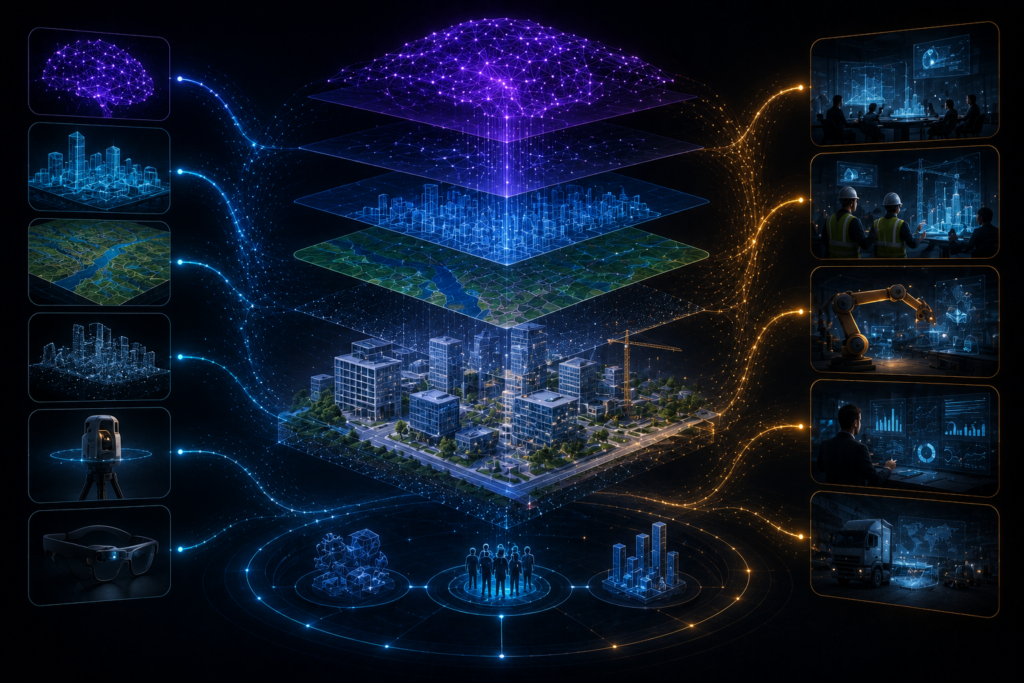
AI needs context. Spatial Computing gives AI access to place, geometry, objects, environments, and human activity. XR gives AI a way to show information in context. Smart glasses give AI a wearable interface. Digital twins give AI a structured model of physical systems. Robotics gives AI a way to act in the physical world.
This is why the intersection matters.
AWEβs 2026 framing around Spatial AI reflects a broader market transition: the future will not be built on AI or Spatial Computing alone. It will be built where they intersect.
π The future wonβt be built on AI or Spatial Computing alone. It will be built where they intersect.
π Real-World Applications
The practical value of AI + Spatial Computing becomes clearer when we look at real-world workflows.
ποΈ AECO and Construction
n AECO, AI-powered Spatial Computing could help teams interpret construction progress, compare field conditions against design intent, identify safety concerns, support inspections, and provide contextual instructions in the field.
Instead of simply viewing a BIM model in AR, a worker could ask:
πΉ What changed since the last scan?
πΉ Is this installation aligned with the design?
πΉ What issues are open in this area?
πΉ What asset am I looking at?
πΉ What should I inspect next?
That is the difference between visualization and intelligent assistance.
π GIS and Infrastructure
GIS workflows could become more conversational, contextual, and field-ready. A spatial AI assistant could help users understand assets, networks, risk zones, maintenance history, and geospatial relationships from the physical location where work is happening.
For transportation, utilities, campuses, and public works, this could change how teams navigate, inspect, and manage infrastructure.
π Manufacturing and Industrial Operations
In manufacturing, AI-powered spatial interfaces could support quality assurance, assembly guidance, maintenance, remote assistance, and training.
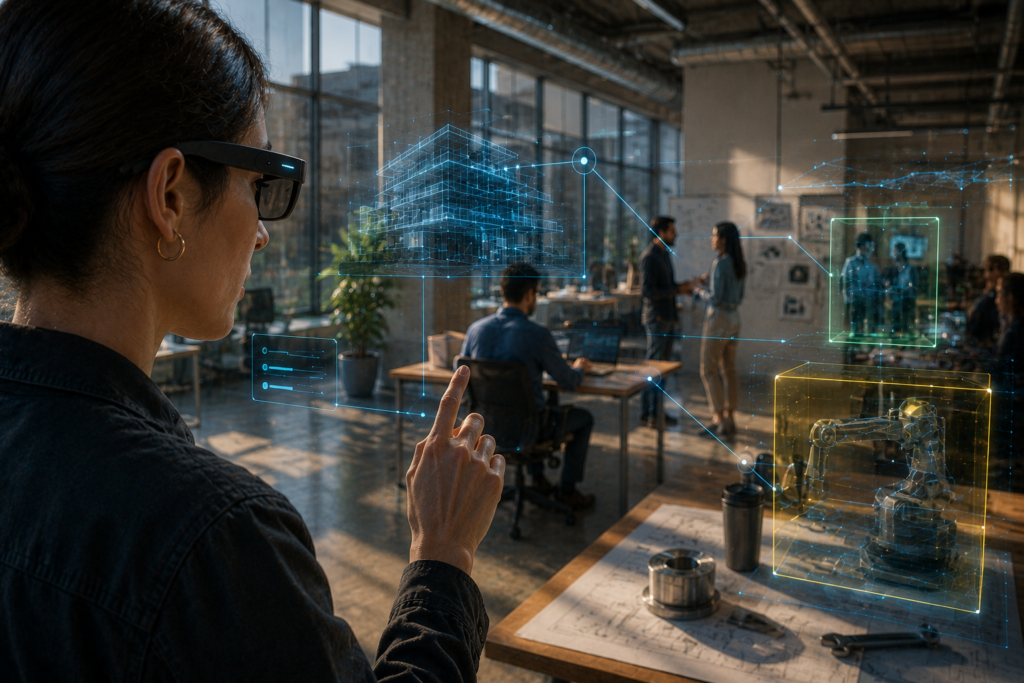
A technician wearing smart glasses could receive real-time support based on the equipment in view, the procedure being performed, and the current operational state.
π Education and Training
Spatial AI could support more personalized immersive learning. Instead of static training modules, AI-powered XR experiences could adapt explanations, pacing, difficulty, and feedback based on what the learner is doing.
π₯ Healthcare
Healthcare applications could include training, surgical planning, clinical simulation, patient education, remote expertise, and facility operations. AI could help make immersive systems more adaptive to the learner, clinician, or patient context.
π¨ Public Safety and Emergency Response
Emergency responders could benefit from spatially aware systems that provide building context, hazard information, navigation, team location, and relevant procedures in real time.
π€ Robotics and Physical AI
Spatial AI also connects directly to robotics. Robots need to understand spaces, objects, people, and tasks. XR can help humans supervise, train, simulate, and collaborate with robotic systems. As Physical AI grows, Spatial Computing may become one of the interfaces humans use to understand and manage autonomous systems.
Across all of these examples, the core shift is the same:
Spatial Computing becomes more valuable when it can understand context.
π‘ Immersioneer POV:
My biggest takeaway from AWE was not a headset or a single product announcement.
It was watching the conversation shift from displays and hardware specs to intelligence, context, and real-world understanding.
That is one of the clearest signs Spatial Computing is entering its next phase.
The first phase of XR asked:
Can we create immersive digital experiences?
The second phase asked:
Can we make the hardware better, lighter, and more usable?
The next phase asks:
Can these systems understand the world well enough to become genuinely useful?
That is the real shift.
Spatial Computing does not become transformative simply because content appears in 3D. It becomes transformative when digital systems understand the physical environment, the userβs intent, and the operational context.
This is why AI is so important.
AI can make spatial systems more adaptive.
AI can make digital twins more actionable.
AI can make smart glasses more useful.
AI can make enterprise XR less like a demo and more like a workflow.
But there is also a challenge.
The industry cannot treat AI as a feature checkbox.
Adding an AI assistant to an XR application does not automatically make it useful. The real opportunity is designing spatial systems where AI, interface, environment, and task are connected from the beginning.
The future will not be defined by better hardware alone.
It will be defined by systems that understand the spaces, objects, and people around them.
π The next era of Spatial Computing belongs to intelligent, context-aware systems.
π§ Immersioneer Takeaway
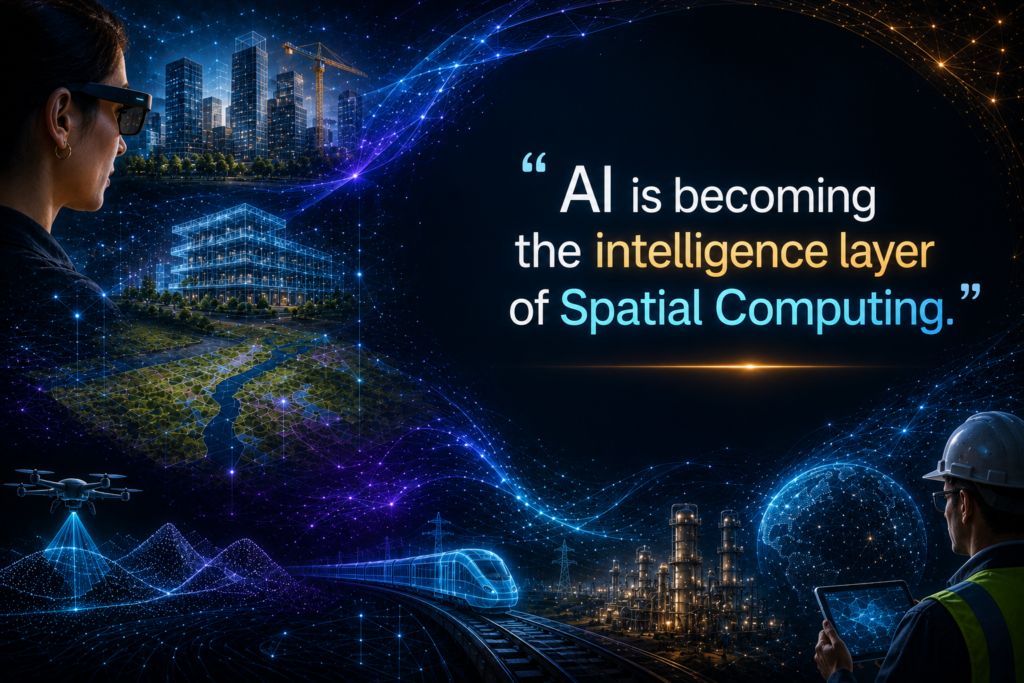
AI is becoming the intelligence layer of Spatial Computing.
Hardware lets us see digital content in the world.
AI helps spatial systems understand what that world means.
The real breakthrough will come when AI, Spatial Computing, Digital Twins, GIS, Reality Capture, VPS, Smart Glasses, and Robotics begin working together as one context-aware computing stack.
π Whatβs Next?
Over the next 2β5 years, AI will likely reshape Spatial Computing in several major ways.
First, spatial interfaces will become more conversational. Users will ask questions, issue commands, and receive guidance through natural language instead of navigating complex menus.
Second, AI assistants will become more context-aware. Rather than answering generic questions, they will interpret the userβs environment, task, location, and history.
Third, Digital Twins will become more actionable. AI will help summarize changes, detect anomalies, generate insights, and support operational decisions.
Fourth, smart glasses will become one of the most important interfaces for AI-powered Spatial Computing. As wearable devices mature, AI assistants may become more useful when they can see and understand from the userβs point of view.
Fifth, enterprise XR will move closer to real workflow integration. The highest-value use cases will not be βcool demos.β They will be systems that save time, reduce errors, improve training, enhance safety, or help teams make better decisions.
Finally, robotics and Spatial Computing will become more connected. As autonomous systems enter more physical environments, spatial interfaces may help humans supervise, teach, simulate, and collaborate with intelligent machines.
This is why AWE 2026 felt important.
It was not just another XR event.
It was a signal that Spatial Computing is maturing into something more intelligent, more contextual, and more operational.
The next era of Spatial Computing will not be defined only by the devices we wear.
It will be defined by the intelligence that understands the world around them.
π Key Takeaways
πΉ AWE 2026 highlighted a major shift from hardware-first XR toward AI-powered Spatial Computing.
πΉ AI is becoming the intelligence layer that helps spatial systems understand context, environments, objects, and user intent.
πΉ Spatial Computing becomes more valuable when it moves beyond visualization into decision support and real-world workflows.
πΉ Digital Twins, GIS, Reality Capture, VPS, Smart Glasses, Robotics, and AI are converging into a broader context-aware computing stack.
πΉ The next generation of enterprise XR will be defined by usefulness, intelligence, and workflow integration.
πΉ The future will not be built on AI or Spatial Computing alone. It will be built where they intersect.
π¬ Continue the Conversation
As AI becomes deeply integrated into Spatial Computing, the conversation is shifting from what devices display to what they understand.
What will have the biggest impact on the future of Spatial Computing?
π€ AI
π Smart Glasses
π Digital Twins
π Virtual Positioning Systems
π₯½ Spatial Interfaces
π€ Robotics
Continue the conversation in the comments or connect with me on LinkedIn as I continue documenting the future of Spatial Computing, AI, Smart Glasses, Digital Twins, Enterprise XR, and context-aware computing.
π Learn more:
https://www.forbes.com/sites/timbajarin/2026/06/18/at-awe-2026-spatial-computing-grows-up-and-ai-is-now-the-story/
The next era of Spatial Computing wonβt be defined by the devices we wear. It will be defined by the intelligence that understands the world around them.