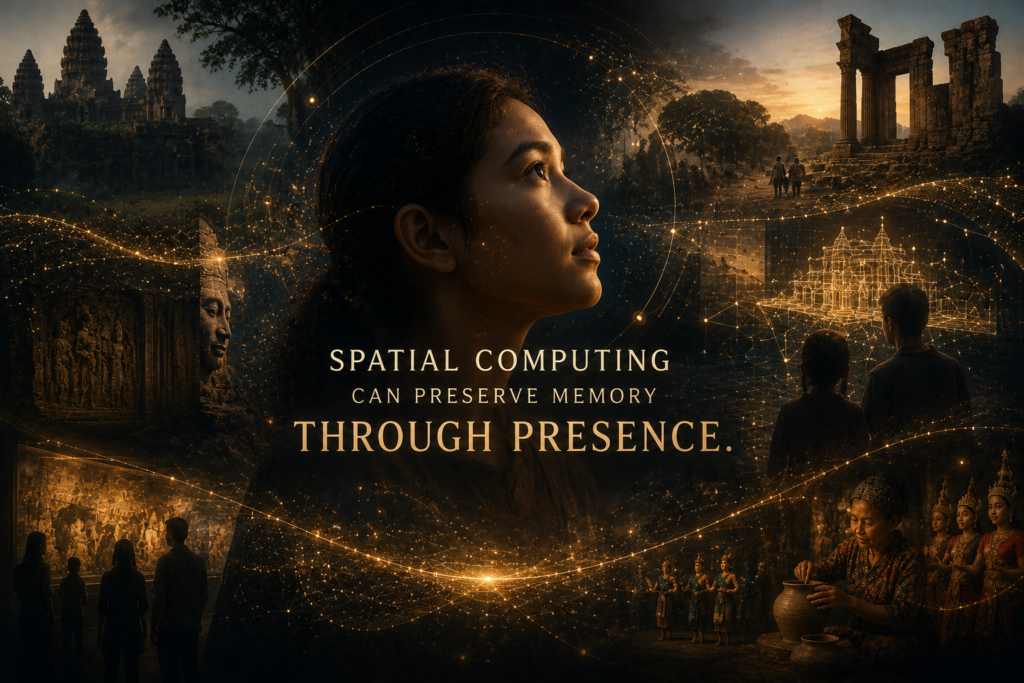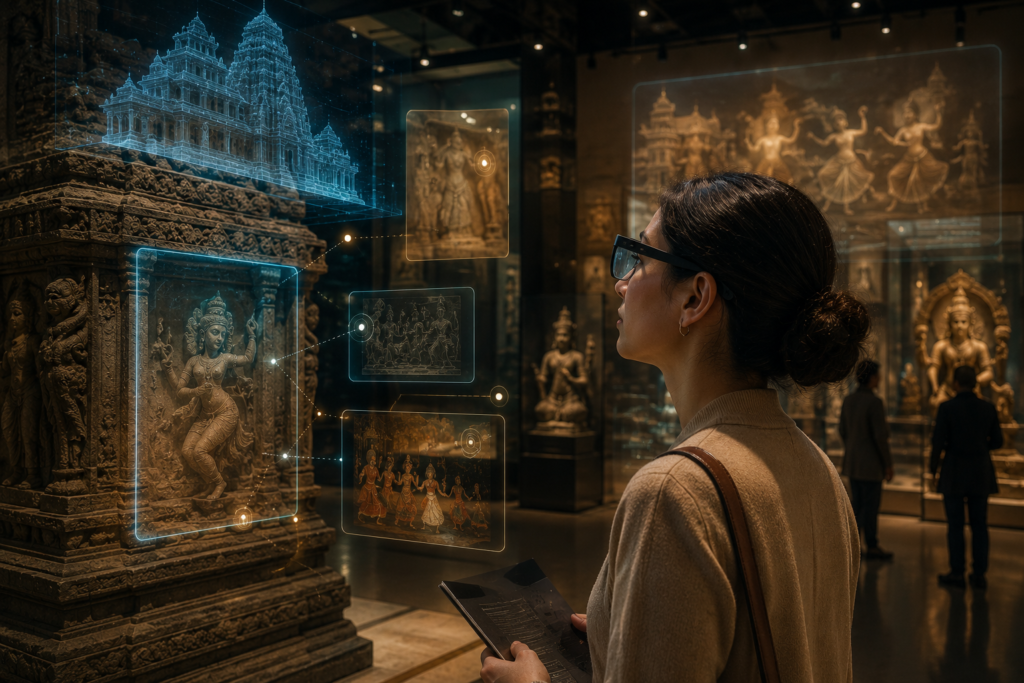
When most people think about AR, VR, and Spatial Computing, they often think about gaming, productivity, training, or entertainment. But one of the most meaningful applications may be cultural preservation. Spatial Computing is not only creating new experiences. It can also help preserve existing ones.
That matters because culture is not only stored in buildings, monuments, artifacts, and museums. Culture also lives in rituals, performances, oral traditions, craftsmanship, language, music, dance, storytelling, and community memory. These forms of heritage can be fragile.
They can disappear when younger generations lose access to them, when traditions are not documented, when communities are displaced, when historic sites are damaged, or when cultural practices are reduced to static records instead of living experiences. This is where immersive technology becomes powerful.
 AR can bring artifacts and historic spaces to life. VR can recreate places, rituals, and environments that people may never otherwise experience. AI can help generate interactive narratives and personalized learning pathways. Social media can help cultural stories reach younger and global audiences.
Together, these technologies are changing how people experience history.
 The future of Spatial Computing may be as much about preserving our past as creating our future.
Researchers, museums, educators, and cultural organizations are increasingly exploring immersive technologies as tools for cultural preservation. A recent article in npj Heritage Science examined how AR/VR storytelling, social media participation, and AI-produced narratives can support the preservation and adoption of digital Intangible Cultural Heritage experiences.
That phrase, Intangible Cultural Heritage, is important. Unlike a building, statue, painting, or physical artifact, intangible heritage refers to living cultural practices. This can include performing arts, rituals, craftsmanship, oral traditions, social practices, and community knowledge passed down across generations.
Preserving this type of heritage is difficult because it is not always enough to scan an object or photograph a site. A dance is not only a set of movements. A craft is not only a finished object. A ritual is not only a recorded event. A story is not only a transcript.
The meaning often comes from participation, context, emotion, sound, gesture, memory, and community. That is why immersive media matters. The Nature article studied factors that influence whether people are willing to adopt digital cultural heritage experiences, including perceived usefulness, ease of use, immersion, authenticity, and social media engagement.
The key insight is that cultural technology is not successful simply because it is impressive.It must feel meaningful.It must feel accessible.It must feel authentic.It must help people connect emotionally and culturally.
This is where Spatial Computing can offer something traditional media often cannot. It can turn cultural preservation from something people observe into something they experience.
Museums, educators, and researchers are already exploring:
AR experiences that bring artifacts to life VR recreations of historical environments AI-supported cultural storytelling Interactive learning beyond traditional exhibits Digital access to cultural practices for broader audiences Social platforms that help heritage reach younger generations
This enables:
 More engaging education Greater cultural accessibility Preservation of traditions for future generations New ways to experience heritage remotely Deeper emotional connection to cultural stories
Technology can help preserve culture while making it more accessible than ever before.
 Why This Matters
Many cultural traditions and historic sites risk being lost over time. Some are threatened by modernization. Some are affected by urbanization. Some suffer from lack of documentation. Some lose continuity as fewer young people learn or practice them. Some are vulnerable to conflict, climate change, neglect, or physical deterioration.
Spatial Computing creates a new preservation toolset. Instead of only documenting culture as text, photos, or video, immersive technologies can preserve spatial context, embodied experience, environment, sound, movement, and interaction. That matters for learning.
Reading about a historic ritual is valuable. Watching a video of it is stronger. But experiencing a spatial reconstruction, hearing the environment, moving through the space, interacting with cultural objects, and understanding the story in context can create a different kind of memory. This does not replace the original cultural practice. That distinction matters.
A digital recreation should never pretend to be the same as the living tradition itself. But it can become a bridge: a way to introduce, teach, preserve, document, and expand access. For education, this can help students engage with history in a more embodied way. For museums, it can turn passive exhibits into interactive cultural experiences.
For tourism, it can help people understand places before, during, and after visiting. For communities, it can support preservation and storytelling across generations. For researchers, it can create new methods for documenting and studying cultural practices.
This enables: Immersive learning Greater public engagement New opportunities for cultural preservation Better access to fragile or distant heritage More emotionally resonant storytelling
The Nature article’s findings reinforce this point. Perceived immersion was one of the strongest factors influencing willingness to adopt digital cultural heritage experiences, followed by perceived usefulness and authenticity. That suggests people are more likely to value immersive cultural experiences when they feel both engaging and meaningful.
Preserving history becomes more powerful when people can experience it rather than simply read about it.
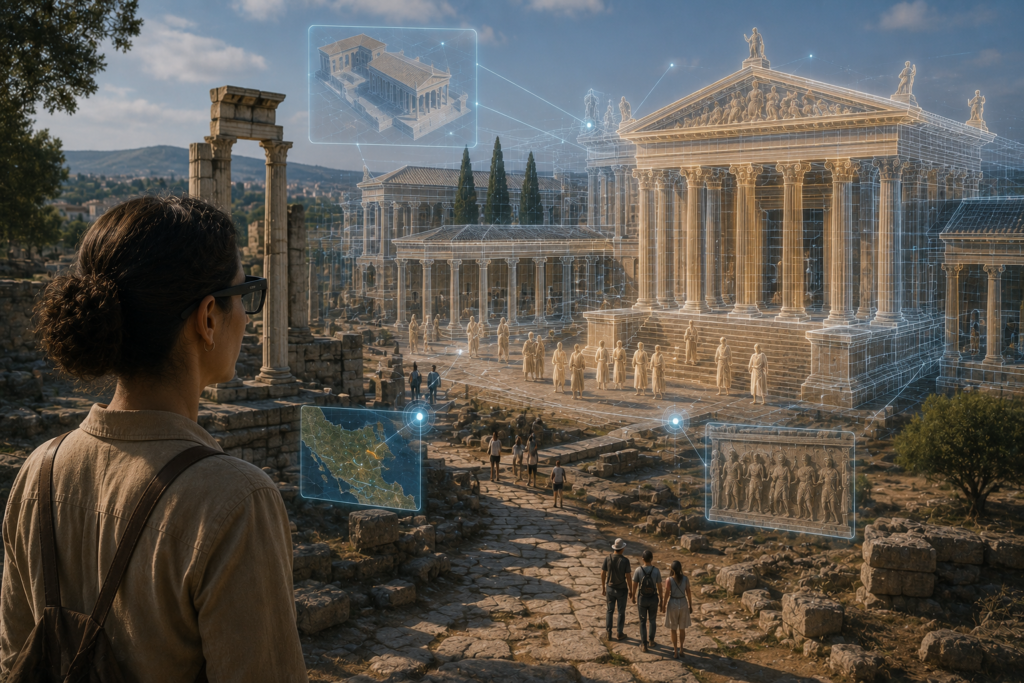
Spatial Computing is expanding into areas of everyday life that go far beyond entertainment and enterprise productivity.
We are seeing immersive technologies move into:
Cultural Heritage Museums Education Tourism Historic Sites Public Memory Community Storytelling Digital Preservation
This is part of a larger pattern: Computing is becoming more experiential. For decades, digital preservation often meant creating databases, archives, scans, images, videos, and web pages. Those tools remain important. But Spatial Computing adds another layer: presence.
Presence changes how people connect with information. A 3D reconstruction can help someone understand scale. An AR overlay can reveal hidden layers of an artifact. A VR environment can place someone inside a historical moment. AI narration can adapt a cultural story to different ages, languages, or learning styles.
Social media can help communities share and discuss heritage in public. Together, these tools can make cultural memory more accessible, participatory, and emotionally resonant. But the bigger pattern also includes responsibility. When technology touches culture, authenticity matters.
The Nature article highlights this tension clearly. Participants appreciated digital recreation and access, but also raised concerns about losing cultural depth or human quality when AI storytelling or digital reconstructions feel too artificial. In other words, digital cultural preservation is not just a technical challenge. It is also an ethical and interpretive challenge.
That is a major lesson for Spatial Computing. The goal should not be to make culture look futuristic. The goal should be to preserve meaning. That requires collaboration with cultural practitioners, historians, communities, educators, museums, and preservation experts. Spatial Computing should not extract culture. It should help protect, share, and honor it.
Spatial Computing isn’t only changing how we work. It is changing how we learn, explore, and remember.
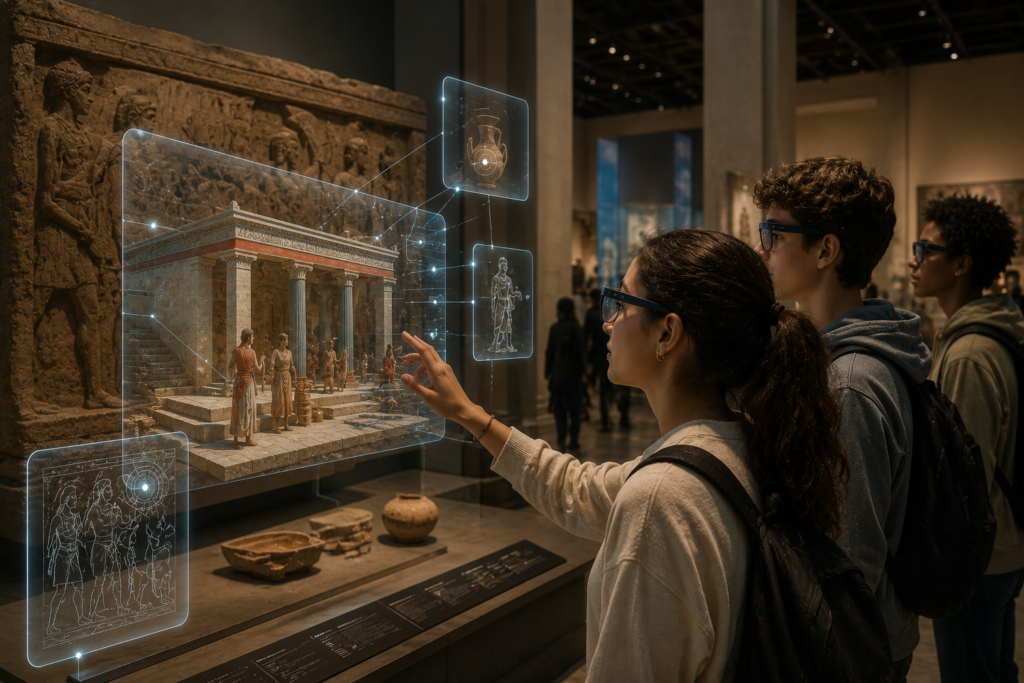
Museums can use AR and VR to add context around artifacts, recreate original environments, show how objects were used, and create interactive exhibits that support different learning styles.
Instead of viewing an artifact through glass, visitors could see its origin, function, story, and cultural meaning unfold around it.
Potential museum applications include: AR-enhanced artifacts Virtual exhibition spaces Interactive historical timelines Multilingual AI guides Immersive storytelling rooms Accessibility features for remote visitors
Spatial Computing can make history and culture feel more tangible for students.
Instead of only reading about an ancient city, students could explore a reconstructed version. Instead of learning about traditional craftsmanship through text, they could observe and interact with a spatial demonstration. Instead of memorizing dates, they could understand context.
Potential education applications include: Immersive history lessons Virtual field trips Cultural storytelling modules Language and tradition preservation Student-led digital heritage projects
Tourism can become more meaningful when visitors understand the cultural layers of a place.
AR could show how a site changed over time. VR could allow people to preview or revisit cultural destinations. AI-guided spatial storytelling could personalize a tour based on interests, language, accessibility needs, or historical depth.
Potential tourism applications include: AR walking tours Historic site reconstructions Cultural route storytelling Remote access to fragile locations Preservation-aware tourism experiences
Spatial Computing can help preserve and interpret sites that are damaged, remote, restricted, or at risk.
This could include ancient architecture, battlefields, sacred places, archaeological sites, historic neighborhoods, and cultural landscapes.
Potential historical site applications include: Digital reconstruction Time-layered AR overlays Preservation documentation Remote guided experiences Public education before site visits
Some of the most powerful use cases may involve intangible heritage: music, dance, oral history, rituals, craftsmanship, and community storytelling. Spatial Computing can help capture not only what happened, but how it felt, sounded, moved, and connected people.
Potential storytelling applications include: VR performances AI-assisted oral history experiences Interactive craft demonstrations Community heritage archives Youth engagement through immersive media
The key is not simply digitizing culture. The key is designing experiences that help people understand why that culture matters.
One of the most exciting aspects of Spatial Computing is its ability to connect people with places in ways traditional media never could.
That connection is not only visual. It is spatial. It is emotional. It is contextual. It is participatory.
From historical sites to digital reconstructions, Spatial Computing can create understanding through presence rather than observation. That is powerful. But cultural heritage is also one of the areas where the industry must be most careful. Not everything should be gamified. Not every tradition should be simplified. Not every cultural story should be automated. Not every AI-generated narrative should be trusted without human review.
The goal should not be to turn heritage into a spectacle. The goal should be to help people connect with culture more deeply, respectfully, and accessibly. The most successful cultural Spatial Computing experiences will likely come from collaboration between technologists and cultural stewards.
Developers can build the tools. Museums can provide curation. Communities can provide meaning. Educators can provide learning structure. Historians can provide context. AI can assist, but people must guide the story.
That is where the opportunity becomes meaningful. Some of the most important Spatial Computing experiences may not be the ones that entertain us. They may be the ones that help us remember who we are.
Some of the most meaningful Spatial Computing experiences may preserve our shared history instead of simply entertaining us.
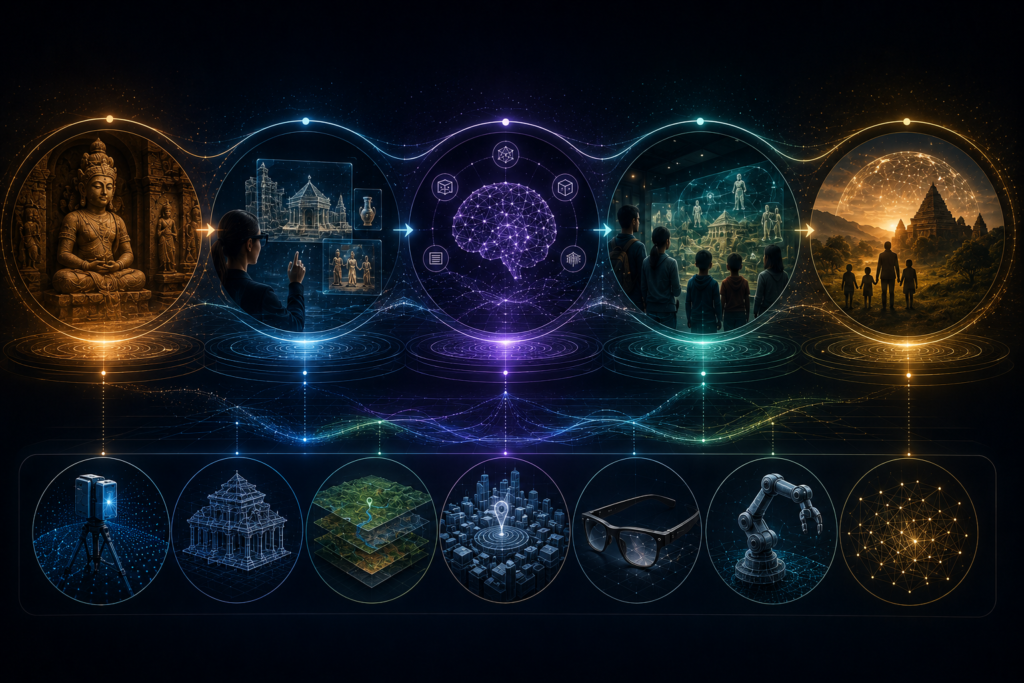
Over the next 2–5 years, cultural heritage may become one of the most important public-facing applications of Spatial Computing. Several trends will accelerate this shift.
First, mobile AR and headset-based experiences are becoming more accessible. As more people gain access to spatial devices, museums and cultural organizations will have more ways to reach audiences.
Second, AI will make cultural storytelling more personalized. Visitors may be able to ask questions, choose narrative depth, hear stories in different languages, or experience adaptive educational paths.
Third, digital twins and reality capture will support more accurate preservation of historic sites and cultural environments.
Fourth, tourism and education will increasingly blend physical and digital experiences.
Fifth, communities will have new opportunities to document and share heritage on their own terms.
But the most important future challenge will be trust.
Cultural Spatial Computing must be accurate, respectful, and authentic. It must involve the people whose heritage is being represented. It must avoid turning living traditions into static simulations or AI-generated approximations without cultural accountability.
If the industry gets this right, Spatial Computing could become one of the most powerful tools for cultural continuity. Not because it replaces tradition. Because it helps more people encounter, understand, and value it.